
Why Rats and Mice Are So Good at Reaching Feeders
The Ground Spill Problem You Can’t Ignore
Baffles: The Most Reliable Physical Barrier
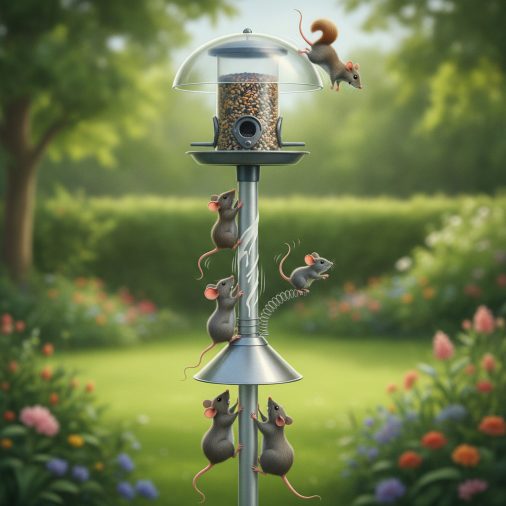
A baffle is a dome-shaped or cylindrical guard that physically prevents rodents from climbing past a certain point on the pole. This is one of the most consistently effective methods available. For a pole-mounted feeder, a cone-shaped baffle positioned roughly 4–5 feet above the ground creates an overhang that rats and mice cannot get past. When they climb the pole and reach the baffle’s underside, there’s nothing to grip or get around. They drop back to the ground. For the baffle to work properly: 1. Place it at the right height — at least 4 feet off the ground so rodents can’t simply jump over it. 2. Keep the pole away from walls and fences — baffles are useless if rodents can bypass them by jumping from a nearby structure. A minimum distance of 5–6 feet from any climbable surface is a practical guideline. 3. Choose a wide enough baffle — a baffle that’s too narrow can sometimes be bypassed by determined climbers. Wider dome baffles with a slippery finish work better. 4. Check that the pole itself isn’t bypassed — if your feeder hangs on a wire or chain from a bracket, rodents may climb the bracket arm instead of the pole. A cage or baffle may be needed there too. For hanging feeders, a dome-shaped baffle mounted above the feeder on the hanging wire creates a similar obstacle from above, preventing rodents from descending along the wire.Making the Pole Itself Harder to Climb
Beyond baffles, there are a few ways to make the pole itself a trickier surface for rodents. Wrapping a section of the pole in a smooth metal sleeve reduces grip. Rats can climb rough surfaces easily, but a smooth, grease-free metal cylinder gives them much less traction. Some bird feeders come mounted on powder-coated or smooth steel poles for exactly this reason. Some people apply a thin layer of petroleum jelly or a similar slippery substance to the pole, though this needs regular reapplication and can potentially coat the feathers or feet of low-flying birds if applied carelessly. A better approach is a smooth metal pole combined with a properly positioned baffle rather than relying solely on slippery coatings. If you’re dealing with persistent rat climbing, check out the detailed guidance on how to stop rats climbing a bird feeder pole for additional physical deterrent strategies.Feeder Placement Makes a Bigger Difference Than Most People Expect
Where you position your feeder matters enormously. A feeder placed near a fence, wall, shed, or under a tree gives rodents multiple climbing routes that baffles alone can’t address. The general rule of thumb: – At least 5–6 feet away from any horizontal surface (fences, walls, raised garden beds) – At least 10–12 feet away from overhanging branches or structures – On a freestanding pole in open ground rather than attached to a building Open placement forces rodents to commit to climbing the pole directly, which is where your baffle does its best work. If the feeder is near a fence, a rat can simply walk along the top rail and step directly onto the feeder — no climbing required.Timed Feeding and Portion Control
One approach that many backyard birders overlook is controlling when and how much seed is available. Rodents are primarily nocturnal, becoming most active after dark. Birds feed during daylight hours. Bringing feeders indoors at dusk removes the overnight food source that rodents rely on. This is inconvenient for some people but highly effective. Even if you can’t bring the feeder inside, removing excess seed from the bowl before dark reduces the reward for any rodent that does manage to reach it. Smaller portions also mean less seed falls to the ground throughout the day. Only putting out as much seed as birds will consume in a few hours is a practical habit that reduces both waste and rodent attraction.Rodent-Resistant Feeder Designs Worth Considering
Some feeders are built with features that make rodent access more difficult. Weight-sensitive feeders, designed primarily to deter squirrels, often work well against rats and mice too. These feeders close off the seed ports when anything heavier than a small bird lands on the perch. Since rats and mice typically weigh more than most songbirds, the ports close before they can access the seed. The Gardman Heavy Duty Fat Ball Feeder and similar cage-style feeders with narrow bar spacing can also limit access for larger rodents, though small mice can squeeze through surprisingly tight gaps. Tube feeders with no tray and minimal ledges give rodents fewer surfaces to sit on while feeding. Compared to open platform feeders or large bowl feeders with wide rims, tube designs are generally more rodent-resistant simply because there’s less space to perch.What Not to Do
A few common attempts to stop rodents often create more problems than they solve. Poison bait placed near a bird feeder is dangerous. Rodenticides can poison birds directly if they consume bait, and secondary poisoning is a serious risk — raptors such as owls and hawks that prey on poisoned rodents can suffer fatal effects. Poison should never be used in areas where birds feed. Glue traps are generally not recommended near bird feeding areas for similar reasons. Non-target animals, including small birds, can become stuck. Removing the feeder entirely for a few weeks is a legitimate reset strategy if rodents have become heavily established. With the food source gone, they’ll eventually move on. When you reintroduce the feeder with baffles and better positioning, you’re starting fresh with better defenses in place.Hygiene Around the Feeder Matters for More Than Just Rodents
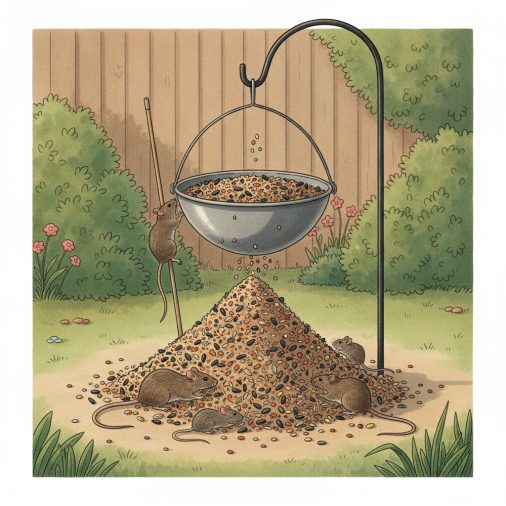
Keeping the area around your feeder clean serves two purposes: it removes seed debris that attracts rodents, and it reduces the risk of disease transmission to birds. Accumulated husks, droppings, and wet seed create conditions where Salmonella and other pathogens can thrive. Sweep or rake beneath the feeder regularly. Clean the feeder bowl itself with a mild detergent solution every couple of weeks. If you use a seed-catching tray, empty and clean it frequently — a tray full of wet, stale seed is attractive to rodents and harmful to birds.A Practical Comparison of Common Deterrent Methods
| Method | Effectiveness Against Rats/Mice | Notes | |—|—|—| | Pole baffle (cone or dome) | High | Requires correct placement and height | | Smooth metal pole sleeve | Moderate | Works better combined with a baffle | | Weight-sensitive feeder | Moderate–High | Works if the rodent is heavy enough to trigger closure | | Removing feeder at dusk | High | Inconvenient but very effective | | Reducing ground spill | Moderate | Reduces initial attraction, doesn’t prevent climbing | | Feeder relocation | High | Essential if near fences or walls | | Petroleum jelly on pole | Low–Moderate | Needs frequent reapplication, minor bird safety concerns | | Poison bait | Not recommended | Serious risk to birds and wildlife |FAQ
Why are rats suddenly appearing at my bird feeder after months without any problem? Rodent populations fluctuate with the seasons. Rats often become more bold and visible in autumn and winter when natural food sources become scarcer. A change in the seed mix, a new neighbor’s feeder nearby, or a shift in local rodent pressure can all trigger sudden activity. If you’ve recently added a new food type like peanuts or suet, these are especially attractive to rodents. Can mice really climb a smooth metal bird feeder pole? Yes, mice are surprisingly capable climbers. A completely smooth, clean metal pole is harder for them than a rough or textured surface, but determined mice can still manage it, particularly if the pole has any joints, seams, or horizontal features to grip. A baffle is far more reliable than relying on a slippery pole alone. Will a squirrel-proof feeder also stop rats and mice? Weight-activated squirrel-proof feeders can deter rats because rats are often heavy enough to trigger the closing mechanism. Mice, however, are very light and may not trigger the weight sensor. For mice specifically, a baffle combined with reducing ground spill tends to be more effective than a weight-sensitive feeder alone. Is it safe to use mint, chili flakes, or other natural repellents near a bird feeder? Birds lack the taste receptors that detect capsaicin (the compound in chili), so chili-coated seed is often used specifically to deter rodents while remaining acceptable to birds. Sprinkling chili powder around the base of the pole may discourage ground-level rodent activity, though it washes away quickly in rain and needs regular reapplication. Mint and similar strong-smelling repellents have limited and inconsistent effectiveness against established rodent populations. How do I know if it’s a rat or a mouse visiting my feeder? Brown rats are noticeably larger — roughly the size of a small potato — with a blunt nose and thick tail. House mice are much smaller with larger ears relative to their body size and a thin, long tail. Both leave droppings, but rat droppings are noticeably larger (roughly 15–20mm) compared to mouse droppings (3–6mm). At dusk, you may observe both species directly, and rats tend to move more cautiously and deliberately while mice often dart and scurry. Should I stop feeding birds altogether if I have a rat problem? Temporarily removing the feeder for a few weeks can help break an established rodent feeding routine. But with the right deterrents in place — baffles, good feeder positioning, reduced ground spill, and no overnight seed — it’s generally possible to continue feeding birds without sustaining a rodent problem long-term. Can rats chew through the feeder bowl itself? Yes, particularly if the bowl is made of plastic. Rats have strong, continuously growing teeth and will gnaw through plastic feeders to access seed. Metal feeders, including those with powder-coated steel or stainless construction, are far more resistant. If you find chew marks on your feeder, switching to a metal design is a practical step.Stopping rodents from reaching your bird feeder bowl is mostly about layering practical barriers — a well-positioned baffle, a clean feeding area, smart feeder placement, and removing overnight access. No single fix is foolproof, but combining two or three of these methods consistently works well for most garden situations. Keeping up with basic feeder hygiene protects your visiting birds as much as it deters unwanted pests.




