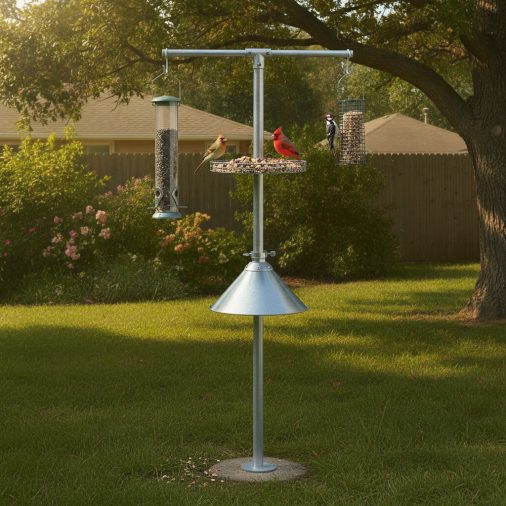
A clothesline pole is often overlooked as a feeder mounting spot, but it can work surprisingly well—especially for backyard birders who already have one standing and want to make good use of it.
You can mount a bird feeder on a clothesline pole using a simple hook, a shepherd’s crook arm adapter, a clamp-on bracket, or a hanging chain attached to the crossbar or vertical post. The best method depends on your pole’s shape, material, and whether you want the feeder hanging freely or secured more rigidly.
Why a Clothesline Pole Can Make a Good Feeder Mount
Clothesline poles are already sturdy, weather-resistant, and positioned in open yard areas—qualities that also make for a solid bird feeder location. Most birds prefer feeders placed in open spaces where they have clear sightlines to spot approaching predators while feeding.
The typical T-shaped clothesline pole gives you a ready-made crossbar to work with. That horizontal bar can support hanging feeders directly, and the vertical post can accept clamp-style brackets or screw-in hooks.
One practical consideration is height. Most clothesline poles stand five to six feet tall, which keeps feeders out of easy reach for ground-level predators like cats and puts them at a comfortable viewing height for you.
Assessing Your Clothesline Pole Before You Start
Not all clothesline poles are the same, and the right mounting method depends on what you’re working with.
Pole material matters. Metal T-posts are the most common and accept clamps, U-bolts, and hook adapters easily. Wooden poles can take screws and eye hooks directly. Older galvanized metal poles may have surface rust, so check the structural integrity before adding weight.
Crossbar style. A standard T-shaped pole has a flat or slightly curved horizontal bar. Some poles have a Y-shape or multiple arms. Any of these can work, but the crossbar width and shape will determine which mounting hardware fits best.
Weight capacity. A typical clothesline pole handles pounds of wet laundry without issue, so most standard bird feeders—even larger tube feeders or platform feeders—won’t stress the structure. Just avoid stacking multiple heavy feeders on one arm without distributing the weight.
Four Practical Ways to Mount a Feeder on a Clothesline Pole
1. Hanging Directly from the Crossbar
The simplest approach. If your feeder has a hanging wire or chain, loop it over the clothesline bar or use an S-hook to clip it on. This works immediately with no tools required.
The feeder will swing freely, which birds generally handle well but can cause seed spillage in windy conditions. Adding a short length of chain gives you better height control and reduces excessive swinging.
2. Screw-In Eye Hooks
For wooden clothesline poles, a galvanized eye hook screwed into the top of the post or the end of a crossbar creates a strong anchor point. Use eye hooks rated for outdoor use to prevent rust.
This method gives the feeder a fixed position with minimal swing. Make sure the wood is sound before threading in the hook—soft, weathered wood won’t hold weight reliably.
3. Clamp-On Bracket or U-Bolt Adapter
Clamp-style feeder brackets grip the vertical post or horizontal arm of a metal clothesline pole without drilling. These are sold specifically as bird feeder pole adapters and typically include a small extended arm that positions the feeder slightly away from the pole itself.
This slight offset is useful—it prevents the feeder from banging against the pole in wind and gives birds more comfortable approach angles. A stainless steel U-bolt clamp with a threaded arm is another similar option that works well on cylindrical metal posts.
4. Shepherd’s Crook Arm Adapter
A shepherd’s crook arm—the curved hook-ended extension—can attach to the side of many clothesline poles using a pole-mount clamp. This creates a traditional extended arm that positions the feeder out to the side of the main structure.
This setup is particularly good if you want to mount multiple feeders, as some adapters include two or three crook arms that fan out from a single mounting point. For backyard birders who want variety, you could hang a tube feeder on one arm and a suet cage on another.
If you’re planning a more dedicated feeding station, the ideas in this guide on how to mount a bird feeder on a pole are worth reviewing alongside your clothesline setup.
Step-by-Step: Mounting with a Clamp Bracket (Most Versatile Method)
This method works on most metal clothesline poles and requires minimal tools.
1. Measure the pole diameter. Use a tape measure or calipers to get the exact diameter of your clothesline post so you can buy a clamp that fits snugly.
2. Select a clamp-on bracket. Look for one rated for outdoor use with a rust-resistant finish. Many include an extending arm or shepherd’s crook.
3. Position the bracket at the desired height. Typically near the top of the post or along the crossbar, depending on your pole’s shape.
4. Tighten the clamp securely. Most use bolts with a hex key or screwdriver. The bracket should not rotate or slide when you apply downward pressure.
5. Hang the feeder using an S-hook or the bracket’s built-in hook. Test the stability by gently pushing the feeder side to side.
6. Fill and observe. Give birds a few days to locate the new feeder. First visitors are often chickadees, house sparrows, or house finches in most North American backyards.
Squirrel Proofing a Feeder on a Clothesline Pole
Squirrels are agile climbers and will scale a clothesline pole in seconds. If you mount a feeder without any deterrent, expect squirrels to empty it regularly.
A pole baffle—a dome or cylinder shaped barrier that wraps around the post—is the most effective deterrent. Install it at least four feet off the ground and away from any surfaces squirrels can jump from, including the clothesline itself. Squirrels can leap horizontally up to eight to ten feet, so positioning matters as much as the baffle itself.
The clothesline cables running from the pole are actually a liability here. Squirrels can walk along the line and drop onto a feeder hung from the crossbar. If this becomes an issue, disconnecting the clothesline cables from the side where the feeder is mounted eliminates that route.
For a more complete look at baffle options, the bird feeder with pole and baffle setup covers squirrel deterrence in practical detail.
Feeder Placement and Bird Safety Considerations
Location affects which birds visit and how safely they can feed. Open areas with at least eight to ten feet of clear space around the feeder help birds spot approaching cats, hawks, or other predators before landing.
At the same time, placing the feeder within ten to fifteen feet of some shrub cover—not directly under it—gives smaller birds like sparrows and warblers a quick escape route. Hawks such as Cooper’s hawks (Accipiter cooperii) and Sharp-shinned hawks (Accipiter striatus) are attracted to yard feeders specifically because small birds concentrate there.
Keep the feeder at least three feet from windows—or ideally more than thirty feet away—to reduce window collision risk. When feeders sit too close to glass at moderate distances, birds flushed from the feeder may fly directly into the reflection. Clothesline poles positioned in the middle of a yard tend to naturally fall into a safe range from most houses.
Keeping the Feeder Clean and the Seed Fresh
A feeder mounted on a clothesline pole is no different from any other when it comes to hygiene. Wet seed spoils quickly, and moldy or rancid seed can harm birds. Clean the feeder every one to two weeks with a diluted white vinegar solution or a mild dish soap rinse, then let it dry completely before refilling.
If your clothesline area gets significant rain or shade, watch for seed clumping inside tube feeders—a common issue in humid climates. Choosing a feeder with good drainage holes and a weather hood helps considerably in wet conditions.
What Feeders Work Best on a Clothesline Pole
Not every feeder type suits every mounting situation. Here’s a quick reference:
Feeder Type
Clothesline Pole Suitability
Notes
Tube feeder
Excellent
Light, hangs cleanly from hook or chain
Hopper feeder
Good
May need a sturdy bracket for larger models
Platform feeder
Moderate
Works well on an extended arm bracket
Suet cage
Excellent
Light and compact, ideal for a second arm
Nyjer/thistle sock
Excellent
Attracts goldfinches, very light
Hummingbird feeder
Good
Keep away from bee-attracting seed feeders nearby
Common Mistakes to Avoid
– Skipping the squirrel baffle. This is the most common oversight and will frustrate you quickly.
– Using an undersized hook or S-hook. Small, lightweight hooks can open or slip under a full, heavy feeder. Use hooks rated for the weight you’re hanging.
– Forgetting the clothesline cables as a squirrel highway. The cables create an access route that negates most baffling.
– Mounting too close to the laundry area. Birds will avoid a feeder where frequent human movement is unpredictable, and seed hulls falling onto clean laundry is its own headache.
– Ignoring feeder height. Mounting very low on the post reduces predator protection. Aim for at least four to five feet off the ground.
FAQ
Can I hang multiple feeders from one clothesline pole?
Yes, a T-shaped clothesline pole can support two or three feeders reasonably well—one from each arm end and one from the center crossbar, for example. Distribute weight evenly to avoid putting stress on one side of the pole. Using a multi-arm shepherd’s crook adapter gives you even more flexibility.
Will birds be scared off by the clothesline cables?
Not typically. Birds are cautious about new structures but quickly adapt to feeders near stationary cables. The bigger issue is that cables give squirrels access. If squirrels are a problem, disconnecting or removing cables from the feeder side helps more than anything else.
What’s the best way to mount a feeder on a round metal clothesline post?
A clamp-style bracket with a U-bolt or adjustable band clamp fits cylindrical posts well. Make sure the clamp diameter matches your post. These brackets are widely available at hardware stores and in bird supply sections. You can also use a Perky-Pet Copper Finish Pole System with compatible clamp adapters if you’re expanding your setup.
Can I screw directly into a metal clothesline pole?
It’s possible with self-tapping screws and a metal drill bit, but it’s generally not recommended. Penetrating the metal can introduce rust at the hole over time and may weaken the pole. Clamp-style solutions are more reliable and don’t damage the structure.
What if my clothesline pole wobbles or isn’t firmly anchored?
Stabilize the pole before mounting any feeder. A loose pole may tip or shift, dropping your feeder. Tamp soil firmly around the base or use expanding concrete around the post anchor. Only add feeders once the pole is stable.
Is a clothesline pole a good long-term feeding station option?
It can be, especially if the pole is already in a good location. For a more dedicated setup with squirrel baffles, multiple feeder arms, and ideal positioning, a purpose-built platform bird feeder with pole may serve you better as your interest in backyard birding grows.
How do I prevent the feeder from spinning in wind?
Use a swivel-style S-hook between the mounting point and the feeder chain. Swivel hooks allow rotation without tangling. Alternatively, use a rigid hook attachment directly to a clamp bracket rather than a free-hanging chain.
Final Thoughts
A clothesline pole can be a genuinely practical feeder location—it’s already installed, positioned in the open, and often at a reasonable height. The key steps are choosing the right mounting hardware for your pole type, adding a squirrel baffle before squirrels discover the feeder, and watching out for the clothesline cables as an access route. Once the setup is stable and the feeder is clean and stocked, most backyard birds will find it within a few days.