
Few things are more annoying than walking out to a clean car and finding bird droppings smeared across your side mirrors. Whether it happens daily or just often enough to frustrate you, there are practical things you can apply or attach to mirrors that actually help.
The most effective things to put on car mirrors to stop birds from pooping on them include physical deterrents like mirror covers or bags, reflective tape, fake predator decals, and scent-based repellents. No single method works universally, but physical barriers that prevent birds from landing on or near the mirror tend to produce the most consistent results.
Why Birds Target Car Mirrors in the First Place
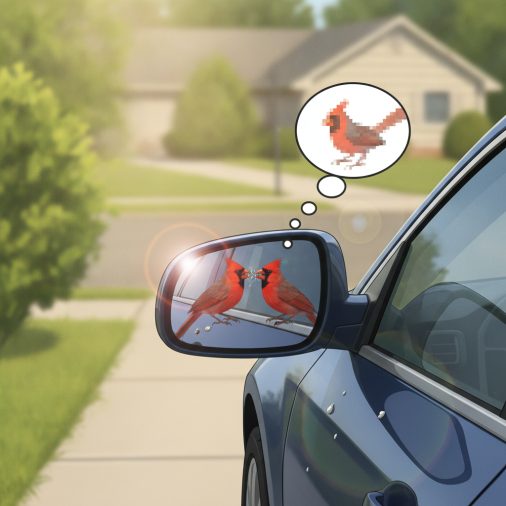
Before trying any deterrent, it helps to know what’s drawing birds to your mirrors. Birds don’t poop on your car deliberately. Droppings usually land on mirrors for two reasons: the bird was perching there, or the bird was attacking the mirror.
Many territorial birds, especially during spring breeding season, see their own reflection in the mirror and interpret it as a rival. House sparrows (Passer domesticus), European starlings (Sturnus vulgaris), American robins (Turdus migratorius), and northern mockingbirds (Mimus polyglottos) are among the most common culprits. They’ll land on or peck at the mirror repeatedly, leaving droppings in the process.
In other cases, birds simply use mirrors as a convenient perch because the housing is a good resting spot. Either way, the result is the same mess.
Understanding which situation you’re dealing with shapes which solution works best. If your birds keep flying into your side mirror repeatedly, the reflection-triggered territorial behavior is likely the cause.
Physical Covers: The Most Reliable Option
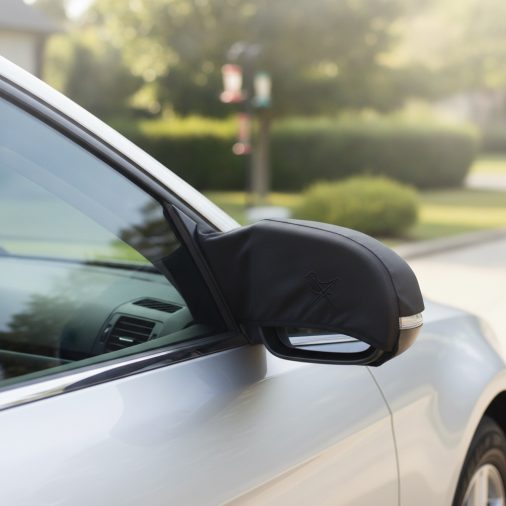
Covering the mirror entirely is the most straightforward way to stop droppings, because it removes both the reflective surface and the perching opportunity at the same time.
Mirror bags or socks — simple fabric bags that slip over your mirror housing — are widely used and genuinely effective. They’re usually made from weather-resistant nylon or polyester. When the mirror is covered, birds can’t see their reflection, lose interest quickly, and have nothing smooth to perch on comfortably.
Old plastic bags secured with rubber bands work in a pinch and cost nothing. They’re not attractive, but they do the job for short-term parking situations.
Dedicated car mirror covers designed specifically for bird problems are also available and tend to fit more securely than improvised solutions. These are worth considering if the problem is persistent.
The main limitation of covers is the inconvenience of putting them on and taking them off every time you park. For drivers who park in a consistent spot each day, this becomes a quick habit. For frequent or unpredictable parking, it’s less practical.
Reflective and Visual Deterrents You Can Apply to Mirrors
Several options work by confusing or startling birds visually, making the mirror area feel unsafe or unstable.
Reflective tape — the kind sold for bird deterrence or general scaring purposes — creates flashing light movement in wind or sunlight. Applied in strips near or around the mirror housing, it can disrupt a bird’s comfort enough to discourage repeated perching. It’s inexpensive and easy to apply.
Predator eye decals or stickers produce mixed results. Some birds respond to large eye patterns, but habituated birds often ignore static images over time. If you try decals, moving them periodically tends to maintain their effectiveness longer than leaving them in one spot.
Holographic or iridescent pinwheels and streamers placed near the parking spot can deter birds from the general area. These work better when they can move, so they’re more suited to a fixed parking spot than to a moving deterrent on the car itself.
One practical consideration is adhesion. Anything applied directly to the mirror housing should be attached in a way that doesn’t leave residue or damage the surface. Low-tack materials or hook-and-loop attachments work better than permanent adhesives on car surfaces.
Scent-Based Repellents That May Help
Birds have a relatively limited sense of smell compared to mammals, but certain scent-based deterrents can still discourage them from landing in an area.
Peppermint oil is one of the most commonly recommended natural deterrents. Soaking cotton balls in peppermint essential oil and placing them near the mirror — in a small mesh bag or tucked into the mirror housing — may deter birds in some situations. Results vary considerably, and peppermint oil needs to be refreshed regularly, especially after rain.
Commercial bird repellent gels like Bird-X Optical Gel are designed to create a sensory deterrent birds find unpleasant — a combination of visual, scent, and tactile discomfort. These gels are typically applied in small dabs to surfaces where birds land. They can be used on mirror housings, though care is needed to keep the gel away from moving mirror parts. These aren’t sticky enough to harm birds, but they make the surface uncomfortable to stand on.
Avoid spraying anything directly onto the mirror glass itself. Most repellent sprays or oils will cause smearing, streaking, or residue that compromises your visibility while driving.
Texture Deterrents: Making the Mirror Housing Less Comfortable
Birds prefer smooth, stable surfaces for perching. Anything that makes the mirror housing feel unstable or physically uncomfortable to stand on can reduce visits.
Bird repellent spikes are designed for ledges and fences, but very small, low-profile versions can sometimes be adapted to larger mirror housings on trucks or SUVs where there’s enough flat surface area. On smaller car mirrors, there’s typically not enough space to make this practical.
Anti-perch strips or gel pads with texture create a less secure footing. These are less commonly used on car mirrors specifically but can work on larger vehicles with broad, flat mirror housings.
A simpler approach is to attach something to the mirror that creates physical awkwardness — a short piece of pool noodle split lengthwise and wrapped around the housing, for example. It’s not elegant, but it changes the landing surface enough that many birds move on.
Parking Location and Habit Changes That Actually Work
Sometimes the most effective deterrent isn’t something you put on the mirror at all — it’s changing where and how you park.
Parking away from trees, power lines, gutters, or fence lines removes the perching structures birds use to approach your car. Birds rarely target mirrors mid-flight; they typically land on a nearby structure first, then move to the mirror. Removing that nearby perch opportunity dramatically reduces incidents.
Parking in a garage is the obvious complete solution, but it’s not available to everyone. If you have partial shelter options, even a carport or a spot beneath an overhang can reduce exposure.
For more comprehensive strategies beyond just the mirrors, practical tips on keeping birds away from your entire car are worth considering alongside mirror-specific solutions.
What to Avoid Putting on Your Mirrors
A few things that circulate in online advice are worth skipping.
WD-40 or oil-based lubricants applied to mirror housings may seem logical since they make surfaces slippery, but they attract dust and grime, can damage rubber seals, and create a smearing hazard if they contact the mirror glass.
Mothballs are sometimes suggested as scent deterrents. They contain naphthalene or paradichlorobenzene, both of which are toxic to birds and other wildlife, and are not an appropriate deterrent in an open environment.
Fake owls and hawk decoys placed on or near your car can briefly startle birds but lose effectiveness quickly once birds realize the decoy never moves. They also look unusual enough to attract attention that might not be welcome on a parked car.
Anything that poses a genuine physical hazard to birds — sharp protrusions, strong adhesive surfaces, toxic coatings — should always be avoided. The goal is deterrence, not harm.
Seasonal Patterns Worth Knowing
The problem often peaks in spring and early summer during breeding season. Territorial behavior in species like robins, mockingbirds, and sparrows is most intense when males are defending nesting territories. During this period, the same car parked in the same spot can attract relentless daily attacks.
By mid-summer, once nesting and fledgling activity winds down, territorial behavior typically decreases significantly in most species. If you’re dealing with a severe seasonal problem, doubling up on deterrent methods during peak weeks (roughly March through June in much of North America) and then reducing them later may be a practical approach.
Migratory species can create short-term spikes during spring and fall migration, when larger numbers of birds move through an area and roost in unusual spots temporarily.
Quick-Reference: What Works, What’s Limited
| Method | How to Apply | Effectiveness | Best For |
|---|---|---|---|
| Mirror covers or bags | Slip over mirror housing | High | Daily parkers in fixed spots |
| Reflective tape | Attach near mirror housing | Moderate | General deterrence |
| Peppermint oil on cotton | Tuck near housing in mesh bag | Low–Moderate | Mild problems, supplemental use |
| Bird repellent gel (e.g., Bird-X Optical Gel) | Dab on housing surface | Moderate | Persistent perchers |
| Predator eye decals | Stick to housing | Low (habituates quickly) | Short-term use |
| Texture strips or padding | Wrap or attach to housing | Moderate | Larger mirror housings |
| Change parking location | No application needed | High | When a permanent spot change is feasible |
Frequently Asked Questions
Does aluminum foil on car mirrors stop birds from pooping on them?
Aluminum foil can work as a short-term deterrent. Wrapped loosely around the mirror housing, it creates an unfamiliar reflective surface and an unstable texture. It’s not durable and looks conspicuous, but for a quick, low-cost temporary fix, it can reduce visits. Replace it as it tears or loosens.
Will clear packing tape on the mirror glass stop birds from seeing their reflection?
Partially. Covering the glass with tape or a non-reflective film reduces the clarity of the reflection, which can decrease territorial attacks triggered by a bird seeing itself. It won’t eliminate the problem entirely and will reduce your own mirror visibility, so it’s not a practical driving solution — only a parked-car option.
How do I stop birds from pecking at my car mirrors specifically?
Pecking at mirrors is almost always territorial behavior triggered by reflection. The fastest fix is covering the mirror glass completely. Physical covers, opaque bags, or even cardboard taped over the glass while parked removes the trigger immediately. More detailed approaches to stopping birds from pecking car mirrors are worth reading if the behavior is severe or recurring.
Is bird poop on car mirrors actually damaging?
Yes, over time. Bird droppings are acidic and can etch into car paint and plastic mirror housings if left for extended periods, especially in hot weather where the uric acid concentrates as the dropping dries. Wiping droppings off promptly — ideally within a day — significantly reduces the risk of lasting damage compared to letting them sit.
Are there any sprays safe to use on car mirrors to repel birds?
Some commercial bird deterrent sprays are formulated to be surface-safe, but always check the label before applying anything to painted or plastic surfaces. Most sprays are better suited to stationary structures like ledges or fences. For car mirrors specifically, scent-based options tucked near the housing (rather than sprayed directly on it) tend to be safer for the vehicle’s finish.
Why does the same bird keep coming back to my mirror every morning?
Territorial birds, particularly during breeding season, are highly persistent. Once a male establishes that a particular mirror is a rival’s territory, he may return to challenge his reflection every day for weeks. The behavior typically stops on its own when nesting activity winds down, but using a physical cover to eliminate the reflection is the most reliable way to break the cycle faster.
Do car mirror covers harm birds in any way?
No. Standard fabric or nylon mirror covers pose no harm to birds. They simply remove the reflective surface and the perching opportunity without any physical risk to the bird.
Final Thoughts
Combining methods tends to work better than relying on any single deterrent. A mirror cover is the most dependable option for a fixed parking spot, while reflective tape or a repellent gel can provide a practical layer of deterrence when covers aren’t convenient. If the problem spikes every spring, adjusting your parking location even slightly — away from trees or overhead perches — can make a noticeable difference without any additional effort.




