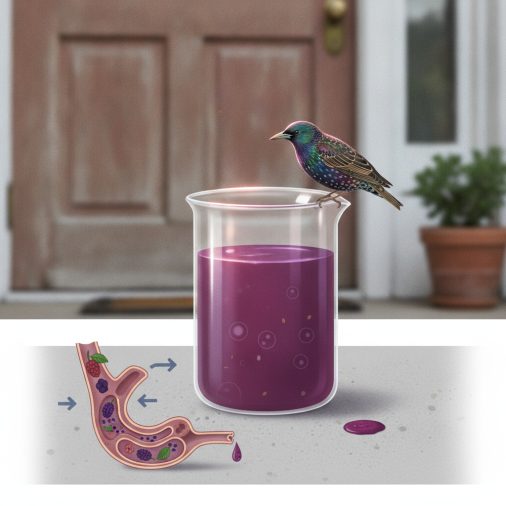
If a bird keeps returning to the exact same spot near your door and leaving behind a purplish liquid, you’re probably wondering whether this is about food, nesting, illness, or something else entirely.
What you’re most likely seeing is a bird repeatedly visiting your doorstep to consume or regurgitate berry-rich food, and the purplish liquid is almost certainly the result of berry droppings or partially digested berry pulp. Some birds return obsessively to productive food sources or territorial spots, and doorways near fruiting shrubs or trees can become consistent stopping points. This behavior is typically harmless but worth examining closely.
What the Purplish Liquid Actually Is
The color is the biggest clue here. Purple or dark reddish-purple liquid near a bird’s repeated landing spot almost always traces back to berries.
Birds that eat elderberries, pokeweed berries, mulberries, wild grapes, serviceberries, or ornamental landscape berries often produce vivid, dark-colored droppings. The pigments in these fruits pass through a bird’s digestive system quickly and can stain surfaces a deep purple or reddish-purple.
This isn’t necessarily blood or anything alarming. Berry-fed bird droppings can look surprisingly liquid and intensely colored, especially when a bird has been eating a lot of ripe or overripe fruit. The more overripe the berries, the more liquid and staining the droppings tend to be.
Why the Same Exact Spot, Multiple Times a Day
Birds are creatures of strong habit, and once a location is associated with safety, food, or territorial routine, they often return to it compulsively.
A few things could explain the precise repetition:
– The spot is a reliable perch near a food source. If there’s a fruiting tree, shrub, or vine near your door, the bird may be using your doorstep as a staging area before or after feeding.
– The bird is marking or defending territory. Some species perch repeatedly in the same spot as a territorial behavior, especially during breeding season.
– Window or door reflection is attracting the bird. A bird seeing its own reflection in a glass door or sidelight may return repeatedly, interpreting the reflection as a rival bird.
– The spot simply feels safe. Covered entryways offer shelter from predators and weather, making them naturally appealing resting spots for many species.
The combination of consistent returning and a purple liquid deposit points strongly toward a berry-eating bird using your entry as a regular perch between feeding trips.
Which Birds Are Most Likely Responsible
Several common North American species are heavy berry eaters and known to frequent doorsteps, porches, and entryways.
Bird
Berry Preference
Behavior Notes
American Robin
Berries, worms
Highly habitual; returns to reliable food spots repeatedly
Cedar Waxwing
Wild berries, especially cedar and serviceberry
Often feeds in flocks; can consume enormous quantities of berries quickly
Northern Mockingbird
Wide variety of berries
Strongly territorial; may return to same spot daily to defend area
European Starling
Berries, fruit
Aggressive and habitual; often found near buildings
House Finch
Berries, seeds
Regular visitor near homes; droppings can stain surfaces
Purple Finch
Berries, buds
Less common at doorsteps but known berry feeder
Cedar Waxwings are particularly worth knowing about. They’re famously relentless berry feeders and can strip a fruiting tree in hours. Their droppings after heavy berry feeding are often strikingly purple or dark red and quite liquid.
Could the Bird Be Sick or Injured?
This is a fair question, and it’s worth considering. A bird that repeatedly returns to the same spot and leaves behind unusual deposits could, in some cases, be showing signs of distress.
Signs a bird may be healthy:
– Alert posture, bright eyes, steady movement
– Flying away quickly when startled
– Returning only briefly before moving on
– No feather ruffling or hunched appearance at rest
Signs to watch for that suggest illness:
– The bird appears lethargic or allows you to approach very closely
– Feathers are puffed up constantly, especially on warm days
– The bird seems disoriented or has trouble flying
– The liquid appears bloody rather than berry-colored
One condition worth knowing about is salmonellosis, a bacterial infection that can affect songbirds and is sometimes associated with congregating near feeders or berry sources. A sick bird may appear unsteady or very docile. If you observe these signs, it’s best not to handle the bird bare-handed and to contact a local wildlife rehabilitator.
That said, if the bird looks healthy, active, and is simply stopping by frequently, illness is unlikely to be the cause.
Is a Nest Nearby?
Repeated visits to the same doorstep spot during spring and early summer can sometimes signal that a bird is scouting or has already begun nesting nearby. Door wreaths are a surprisingly popular nesting location for several species, including American Robins and House Finches. If you have a wreath, decorative foliage, or a sheltered ledge near your entry, it’s worth checking for a nest.
A bird nesting in a door wreath is more common than most people expect, especially in spring. If a nest is present, the repeated visits make complete sense — the bird is tending eggs or chicks, and the purple droppings may be from berries the adult is eating between feeding visits to the nest.
During nesting season, it’s important to avoid disturbing the area. In the United States, most native songbird nests are protected under the Migratory Bird Treaty Act, meaning it’s illegal to remove or disturb an active nest.
The Reflection Problem: When a Bird Attacks Your Door
If the bird seems to be flying directly at the door rather than simply landing near it, reflection is a strong possibility. Glass doors and sidelights create mirror-like reflections that birds can interpret as rival birds intruding on their territory.
This is especially common with Northern Mockingbirds, American Robins, and Northern Cardinals during breeding season. The bird may repeatedly strike or hover at the same spot, and droppings accumulate directly below the reflection point.
Reducing the reflection is the most practical fix. Options include:
– Applying window collision deterrent tape or decals to the glass surface
– Temporarily covering the glass with paper or fabric from the outside
– Installing a screen or mesh over the reflective surface during breeding season
The WilsonPro Bird Tape (also known as bird scare tape) is sometimes used outdoors near entryways to disrupt reflections and discourage persistent birds, though results vary by species and individual bird.
Should You Be Concerned About the Purple Staining?
Berry droppings can stain concrete, wood, and painted surfaces. If the same spot is being hit multiple times a day, the staining can become significant fairly quickly, especially with species like starlings or waxwings that produce high volumes of berry-rich droppings.
For cleaning, a mixture of warm water and mild dish soap works for most surfaces. For tougher staining on concrete, a diluted white vinegar solution applied before scrubbing can help lift berry pigments. Avoid harsh bleach-based cleaners on painted wood or sealed decks, as they can damage the finish.
If the pattern continues, adding a physical deterrent like bird spikes or a visual deterrent near the landing spot can redirect the bird without causing harm.
Practical Steps to Discourage Repeated Visits Without Harming the Bird
If the daily visits are becoming a nuisance, there are humane ways to discourage the behavior:
1. Identify and address the berry source. If a fruiting shrub or tree near your door is attracting the bird, consider pruning it or choosing a non-fruiting variety when it’s time to replace plantings.
2. Install a visual deterrent. Hanging reflective tape, pinwheels, or other motion-based deterrents near the entry can make the spot feel less inviting.
3. Address reflections on glass. Use non-reflective window film or decals to reduce the mirror effect on glass doors.
4. Check for a nest. If a nest is present, leave it alone and the bird will move on naturally once the nesting cycle is complete.
5. Keep the area clean. Regularly cleaning up droppings and removing any food attractants reduces the association the bird has formed with the spot.
FAQ
Why does a bird keep coming back to the exact same spot every day?
Birds develop strong location habits, especially when a spot provides food access, a territorial vantage point, or shelter from predators. Once a location is associated with safety or a reliable food source, a bird may return dozens of times daily. Reflection in glass doors can also cause persistent revisiting, as the bird perceives its own reflection as a territorial rival.
Is the purple liquid a bird leaving near my door dangerous to humans?
Berry-based bird droppings are generally not dangerous on contact, though bird droppings of any kind can carry bacteria such as Salmonella, and dried droppings can carry fungal spores. It’s reasonable to wear gloves when cleaning accumulated droppings and to wash hands thoroughly afterward. Avoid sweeping dry droppings without dampening them first, as this can release particles into the air.
What berries cause purple bird droppings?
Pokeweed, elderberry, mulberry, wild grape, serviceberry, and ornamental landscape berries such as beautyberry and privet are common culprits. Cedar berries fed upon by Cedar Waxwings can also produce very dark droppings. The more concentrated the berry pigment and the more fruit consumed, the darker and more liquid the resulting droppings tend to be.
Could the bird be using my doorstep as a nest site?
Yes, particularly if it’s spring or early summer. Sheltered entryways, ledges, and door wreaths are appealing nest sites for several species, including American Robins, House Finches, and Barn Swallows. Look carefully for nest material or a small cup-shaped nest in any nearby ledges, fixtures, or decorative foliage.
Can a bird returning to the same spot be a sign of illness?
Repeated visits alone aren’t a reliable illness indicator. A healthy bird with a strong routine may visit dozens of times daily without any health issue. Illness is more likely when the bird also shows signs of lethargy, puffed feathers, unsteady movement, or allows very close human approach. If you observe those signs, contact a local wildlife rehabilitator rather than handling the bird yourself.
What kind of bird is most likely leaving purple droppings near a door?
Cedar Waxwings, American Robins, European Starlings, and Northern Mockingbirds are among the most frequent producers of berry-stained droppings near homes. Cedar Waxwings in particular are known for producing vivid, intensely colored droppings after heavy berry feeding. If you’re unsure which species is visiting, the Merlin Bird ID app by the Cornell Lab of Ornithology can help you identify birds by photo or sound from your doorstep.
Does this behavior have any symbolic meaning?
Birds visiting doors and entryways have long carried symbolic significance in many cultures. If you’re curious about the broader meaning people attach to birds appearing at the home, the topic of what it means when a bird visits your home has been interpreted in many different ways across cultures and traditions.
Putting It All Together
A bird repeatedly flying to your front doorstep and leaving a purplish liquid in the same spot is almost always explained by a combination of berry-rich diet, strong location habits, and the natural appeal of sheltered entryways. The purple color is the clearest indicator — it points directly to berry consumption, not injury or illness.
Check for a fruiting plant nearby, look for signs of a nest in or around your entryway, and observe whether the bird is targeting a glass reflection. Those three factors cover the vast majority of cases. If the visits are unwanted, humane deterrents and addressing the underlying attractant are far more effective than trying to shoo the bird away repeatedly.