
Walk through any tropical rainforest—or even browse a wildlife photo gallery—and the difference is striking. Birds in the tropics often look like living jewels, while many birds in cooler regions wear far more muted tones.
Tropical birds tend to be more colourful because of a combination of evolutionary pressures unique to their environment: intense competition for mates, year-round breeding opportunities, dense vegetation that makes visual signals essential, rich food sources that support pigment production, and relatively lower predation pressure from certain types of predators compared to open-habitat birds. No single cause explains it completely—it’s the result of several factors working together over millions of years.
What Colour Actually Is on a Bird’s Feather
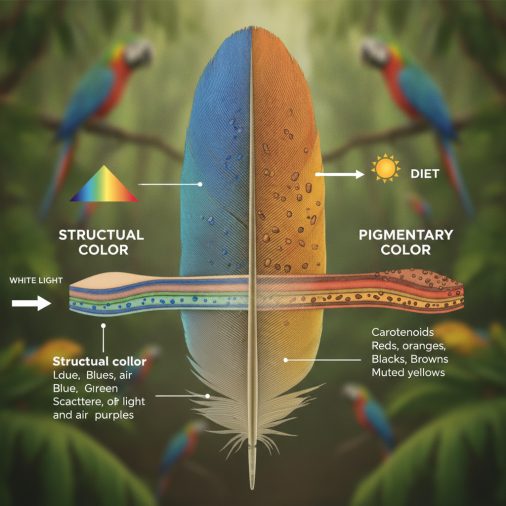
Before exploring why tropical birds are so vibrant, it helps to understand where feather colour comes from. There are two main sources: pigments and structure.
Pigments are chemical compounds deposited directly into the feather during its growth. Carotenoids produce reds, oranges, and yellows, and birds obtain them through their diet—fruits, insects, and other food sources. Melanins produce blacks, browns, and greys, and birds synthesise these internally.
Structural colour works differently. Microscopic structures within the feather physically manipulate light, creating iridescent blues, greens, and purples—colours that seem to shift as the angle of light changes. The Resplendent Quetzal (Pharomachrus mocinno) and many kingfishers display this kind of structural iridescence. Both pigment-based and structural colours can appear in the same bird, which is partly why tropical species often look so complex and layered.
Sexual Selection: The Drive to Stand Out
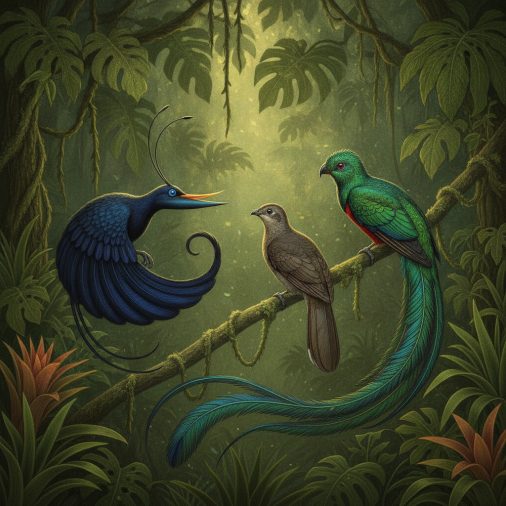
The most powerful force behind tropical bird colouration is sexual selection. In many species, females choose mates based on the quality of their plumage. Brighter, more vivid males are often signalling good health, genetic fitness, and the ability to find food—all qualities a female would want passed on to her offspring.
In the tropics, this process tends to be more extreme. Tropical environments support longer breeding seasons, and in some regions birds can breed year-round. More breeding opportunities mean more competition among males, and sustained competition over long periods drives more dramatic colour displays over evolutionary time.
This is especially visible in groups like Birds of Paradise (Paradisaeidae) in New Guinea, Toucans (Ramphastidae) in Central and South America, and Sunbirds (Nectariniidae) across Africa and Asia. Males in these families have evolved extraordinarily vivid plumage precisely because female preference has driven selection toward the most visually striking individuals.
Dense Habitat and the Need for Visual Signals
Tropical rainforests are visually complex environments. Thick canopy, layered vegetation, and low light conditions make it difficult for birds to communicate at a distance. In these settings, bright colours serve as reliable short-range signals—for finding a mate, defending a territory, or identifying a member of the same species.
In open environments like grasslands or tundra, birds often rely more on song and posture, and camouflage can matter more for survival. In dense tropical forest, a bold colour patch may actually be more effective than subtle markings—and in some cases, bright colouration only becomes visible at close range, offering a degree of natural concealment in the dappled light of the forest floor.
This is one reason many tropical birds have evolved colours that seem almost impossibly vivid in photos but can blend deceptively into filtered forest light in practice.
Diet, Pigments, and Food Abundance
Tropical ecosystems are extraordinarily rich in food. Fruiting trees produce year-round, flowers provide reliable nectar, and insect diversity is vastly higher than in temperate regions. This abundance directly supports feather colour.
Carotenoid pigments—responsible for many reds, oranges, and yellows—must be obtained from food. Birds cannot synthesise them internally. Species with consistent access to carotenoid-rich fruits and insects can produce and maintain more vivid plumage than birds in environments where food is seasonal or scarce.
The Scarlet Macaw (Ara macao) is a good example. Its brilliant red, yellow, and blue feathers reflect both the carotenoids obtained from its diet and the structural properties of its feathers. Consistent access to tropical fruits supports that level of colour intensity in ways that would be difficult to sustain in harsher climates.
You can explore more about where tropical birds choose to live and how their habitat shapes them to understand how food availability and habitat structure are closely connected.
Predation Pressure and the Colour Trade-Off
In many environments, being colourful is dangerous. Bright colours attract predators, which creates strong evolutionary pressure toward camouflage. This is one reason many temperate-zone birds—especially ground-nesting species—are brown and streaky.
In tropical rainforests, the relationship between colour and predation is more nuanced. Many highly colourful tropical birds are also toxic or distasteful to predators. Poison dart frogs use a similar strategy, a principle called aposematism—advertising danger through vivid colour. Pitohuis (Pitohui species) in New Guinea are among the few birds known to carry toxins in their feathers and skin, and they are strikingly coloured.
Even among non-toxic species, predation pressure in dense forest canopy may be lower for birds that stay high in the trees. When escape from predators is achieved through behaviour and habitat rather than camouflage, the evolutionary cost of being colourful drops significantly—making vibrant plumage a more viable strategy.
Species Recognition in Biodiverse Environments
Tropical regions hold a far higher density of bird species than temperate zones. A single hectare of Amazonian rainforest may support more bird species than an entire county in northern Europe. In this context, species recognition matters enormously.
Distinct colour patterns help birds quickly identify members of their own species, find compatible mates, and avoid costly mismatches with related species. Vivid and species-specific markings reduce confusion in environments where many visually similar birds may be competing for the same resources.
This is one reason why even closely related tropical species often differ dramatically in colour—distinct visual identities reduce interbreeding errors and help maintain species boundaries in high-diversity habitats.
Climate Stability and Evolutionary Time
The tropics have remained relatively climatically stable over millions of years compared to temperate regions, which have experienced repeated glaciation and dramatic climate shifts. This long-term stability has allowed tropical bird lineages to diversify and evolve in place over enormous timescales without the periodic resets caused by mass displacement or population bottlenecks.
More evolutionary time in a stable environment, with sustained sexual selection and ecological specialisation, has given tropical birds far longer to develop complex and varied plumage traits. Many of the most spectacularly coloured bird families—Cotingas, Trogons, Bee-eaters, Kingfishers—have ancient lineages deeply rooted in stable tropical zones.
Why Temperate Birds Are Often More Drab
It’s worth clarifying that temperate birds are not uniformly dull. Blue Jays, Northern Cardinals (Cardinalis cardinalis), and European Kingfishers (Alcedo atthis) are striking birds. But as a general pattern, temperate species do tend toward less saturated, more camouflaged plumage.
This reflects the pressures of seasonal environments: harsh winters, seasonal food scarcity, longer migration routes, and greater predation exposure in open or partially vegetated habitats. When survival through a difficult winter matters as much as attracting a mate in spring, evolution tends to favour compromise rather than extravagance.
Tropical birds largely escape these trade-offs. Food is available year-round, temperatures are stable, and breeding opportunities persist far longer—all of which allow evolution to favour appearance over concealment.
For a deeper look at some of these patterns, the article on why tropical birds burst with vibrant reds, blues, and yellows covers additional context about how these colours develop.
Notable Examples Worth Knowing
A few species illustrate these principles particularly well:
| Species | Region | Key Colour Feature | Primary Cause |
|---|---|---|---|
| Resplendent Quetzal | Central America | Iridescent green, red | Structural colour, sexual selection |
| Scarlet Macaw | Central/South America | Red, yellow, blue | Carotenoid diet, sexual selection |
| King Bird of Paradise | New Guinea | Red, white, iridescent | Extreme sexual selection |
| Rainbow Lorikeet | Australia/Pacific | Full spectrum | Sexual selection, species recognition |
| Lilac-breasted Roller | Africa | Multi-coloured | Structural and pigment-based, mate competition |
| Sunbird species | Africa, Asia | Iridescent green, red | Structural colour, sexual selection |
FAQ
Do female tropical birds also have bright colours?
In many tropical species, females are noticeably duller than males—a pattern called sexual dimorphism. This reflects the fact that females often do the nest-sitting and benefit more from camouflage. However, in some species where both sexes contribute equally to territory defence or where mutual mate choice occurs, females can also be quite colourful. Rainbow Lorikeets are a good example where both sexes are equally vivid.
Are colourful tropical birds harder to spot in the wild?
Surprisingly, yes—often. Photos taken in open settings make tropical birds look impossibly bright, but in their natural habitat, dappled forest light, dense foliage, and the angles at which colour patches are visible can make even brilliant species genuinely difficult to spot. Many experienced birders note that hearing a bird is often far easier than seeing it, regardless of how vivid its plumage is.
Does diet directly affect how bright a tropical bird’s colours are?
For pigment-based colours, yes. Carotenoid-dependent colours like reds and yellows can fade or become less vivid in birds that have poor access to carotenoid-rich foods. This is well documented in captive birds and is one reason that high-quality diets are essential for keeping tropical parrots and other colourful species in good condition. Structural colours like iridescent blues and greens are less affected by diet.
Why do some tropical birds have only one or two bright patches rather than full-body colour?
Partial colouration often reflects a balance between visibility and camouflage. A bright throat patch or wing bar can serve as an effective signal during displays while the rest of the bird remains relatively inconspicuous. This strategy lets a bird advertise its fitness to potential mates without broadcasting its location to predators at all times.
Are tropical birds in captivity as colourful as wild birds?
They can be, provided they receive an appropriate diet rich in carotenoids. In practice, some captive tropical birds kept on poor diets show reduced colour intensity over successive moults. Reputable breeders and keepers pay close attention to nutrition, and products like Lafeber Nutriberries (available for parrots and tropical species) are specifically formulated to support feather health and pigmentation.
Do city or urban tropical birds lose their bright colours over time?
There is limited evidence that urbanisation affects colouration directly, though habitat degradation and dietary changes in urban environments could theoretically reduce carotenoid intake for some species. This is an area of ongoing ornithological research. In general, wild tropical birds in intact habitats maintain their characteristic colours through natural foraging.
Is colour in tropical birds always about attracting mates?
Not always. Colour also functions in species recognition, territorial signalling, warning predators (aposematism), and mimicry. Some species mimic the colours of toxic or dangerous animals without being toxic themselves—a strategy called Batesian mimicry. Sexual selection is usually the dominant driver, but colouration in birds is rarely single-purpose.
A Few Final Thoughts
Tropical bird colour is the product of millions of years of evolution shaped by diet, competition, habitat, climate stability, and the relentless pressure of mate choice. No single explanation covers every species, and the interplay between these factors is part of what makes tropical ornithology so fascinating.
Understanding these mechanisms also has a practical side for bird keepers—diet quality directly affects pigment-based plumage, which is worth keeping in mind for anyone caring for tropical parrots or softbills. For those who simply enjoy watching or photographing these birds, knowing what drives their colours adds a layer of meaning to every sighting.
The short version: tropical birds are more colourful because their environment rewards extravagance in ways that harsher climates simply do not.




